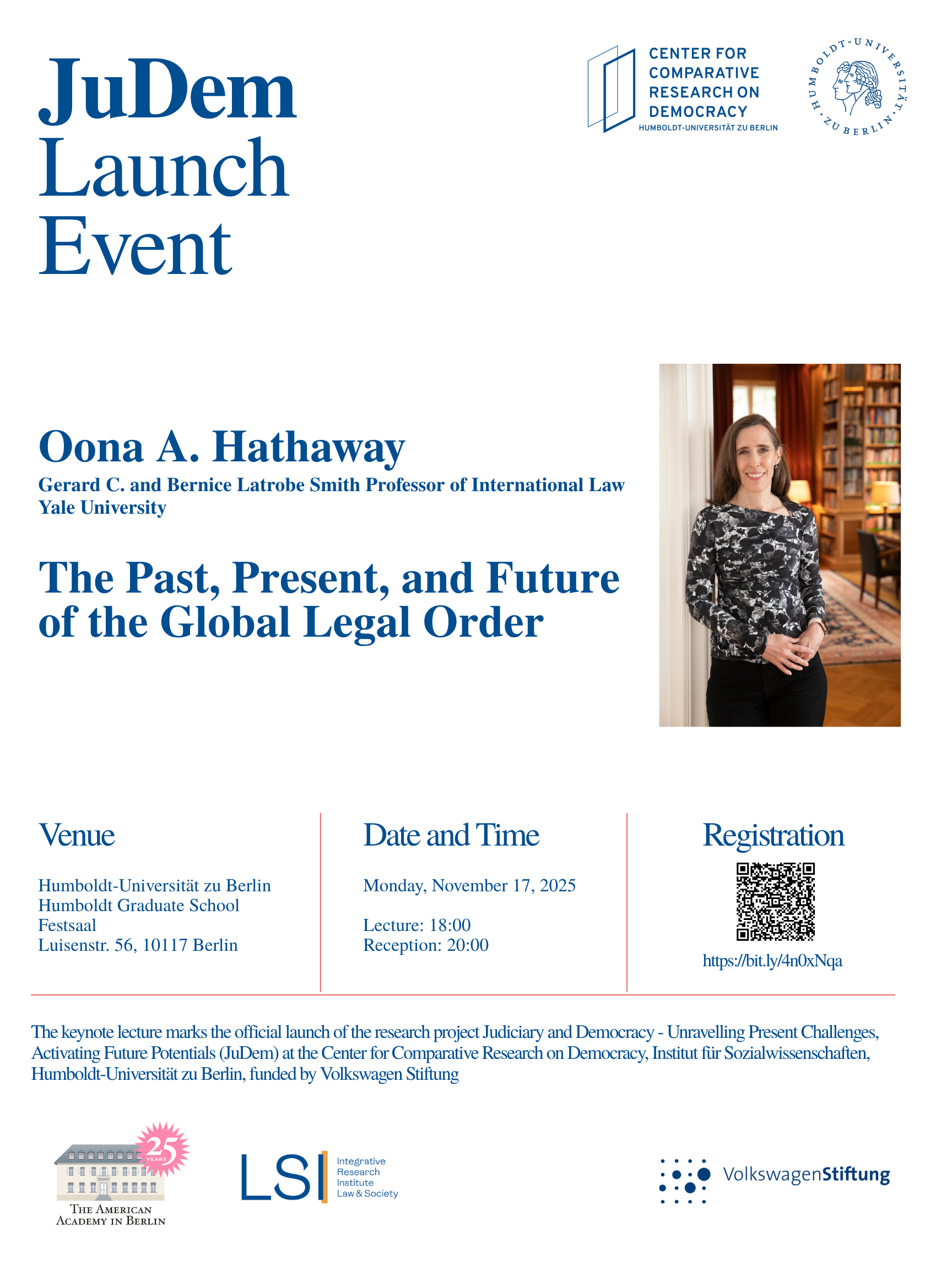
JuDem Launch Event
On 17 November 2025, the launch event of the research project Judiciary and Democracy – Unravelling Present Challenges, Activating Future Potentials (JuDem) was held at the Festsaal of Humboldt-Universität zu Berlin. The event was organized by CCRD in collaboration with the Integrative Research Institute Law & Society and the American Academy in Berlin, and brought together scholars, legal practitioners, and members of the academic public.
The event opened with welcoming remarks by Prof. Dr. Claudia Becker, Dean of the Faculty of Humanities and Social Sciences at Humboldt-Universität zu Berlin. In her address, she emphasized the trans- and interdisciplinary character of the JuDem project and highlighted its academic relevance in light of current challenges to democratic governance and judicial institutions.
Following the welcome, Prof. Dr. Silvia von Steinsdorff introduced the central research questions guiding JuDem and explained the project’s methodological approach. She outlined the rationale behind the Living Research Lab format, which aims to foster sustained exchange between academic research and legal practice.
The international partners of the project, Prof. Dr. Ece Göztepe and lawyer İpek Bozkurt, then briefly presented their respective roles and perspectives within the project, situating their contributions within the broader comparative and transnational framework of JuDem. Dr. Gülçin Balamir Coşkun subsequently introduced the research team and their areas of expertise.
Prof. Dr. Silvia von Steinsdorff then introduced the keynote speaker of the evening. The keynote lecture, titled "The Past, Present, and the Future of the Global Legal Order", was delivered by Prof. Oona A. Hathaway (Yale Law School). Throughout the lecture, Oona A. Hathaway traced back the historical origins of international law and the global legal order so that we might come to a better understanding of the present.
Hathaway underlined that the global legal order is currently under severe strain and that there is a real risk of losing achievements built over the past century. At the same time, she cautioned against idealizing the past, noting that the global legal order has always been marked by exclusions and shortcomings. Rather than abandoning it altogether, she argued for the need to defend its core principles while developing new and creative responses to contemporary challenges. “We might be on the precipice of a shift away from the global legal order to something new…” Hathaway said as she laid out what might be done in this current situation. Most pressingly, she emphasized that new ideas are needed: “Now more than ever, we need creative new ideas for strengthening, reinforcing and reforming the international legal order”.
This perspective resonates with the starting point of JuDem. The project proceeds from the diagnosis that democracy is in crisis and that autocratic leaders across different contexts are actively undermining democratic norms and institutions. At the same time, JuDem does not assume that these attacks are directed at an otherwise fully functioning liberal democratic order. Instead, it takes seriously the need to rethink democracy beyond established liberal models, while simultaneously resisting authoritarian erosion. In this sense, JuDem situates itself at the intersection of critique and reconstruction, seeking to explore how democratic futures might be imagined under conditions of profound transformation. The lecture was followed by a lively discussion, with questions and comments from the audience.
“The Past, Present, and the Future of the Global Legal Order”
Prof. Oona A. Hathaway, Yale Law School